
Students who want to challenge themselves have one go-to answer- the college board, an organization that provides advanced-placement classes and standardized tests nationwide. Essentially, it’s the reason behind every junior’s sudden dip in charisma near the end of the year. For many high schoolers, the mere sight of an acorn has become their trigger.
While the Board grants high schoolers opportunities to achieve more and further their own goals, it’s also been hailed by the victims of their notorious AP tests as a purely evil operation. Thus, the board serves as most teenagers’ punching bags as a much needed scapegoat of their frustrations. Regardless of how much hate teachers and students alike have for the organization, lets ask ourselves this: what is the college board, how does it operate, and is it truly wrong?
What is the College Board?
Let’s start by exploring what it is. The College Board claims to be a “not-for-profit” organization, meaning that rather than investing it’s profit into the public cause, it is generally reinvested into the organization itself to better its services and quality. So, essentially, for profit without a mega-rich CEO; which is still a stretch because he makes $2.5 million a year. Top board executives make upwards of $300k a year, and criminally, they have charged the average high-schooler an average of just about $400 to take their tests. Are these high fees and high salaries truly necessary?
What makes the board money, and has kept them so powerful within America’s education system, is their standardized tests. Tests like the SAT and various AP exams are truly major factors in college admissions. To put it bluntly, these exams weed kids out. Not even through accurate, in-depth tests as you’d hope it to be; just exams designed to be taken in three hours or so by anxiety-ridden high schoolers.
How is the College Board Constructed?
The board offers its membership to educational institutions, and so Over 6,000 high schools, colleges, and universities are members, and thus receive resources for students and educators created by the board itself. Structurally, the organization is surprisingly complex. It is composed of three bodies: the Board of Trustees, three national assemblies, six regional assemblies, and a surprise fourth, Freddy Kreuger who has come to take his revenge on children in the form of standardized tests.
Because it is the most integral of the three, lets discuss the Board of Trustees. This is the governing body of the College Board, elected by member schools and totaling thirty-one officials. The body is made up of national, regional, and assembly elected trustees, but most importantly, the lead trustees. The lead is comprised of four positions: the chair, vice chair, immediately preceding chair, and CEO of the College Board, which, lets be honest, having an “immediately preceding chair” is like having a backup vice president- why?
What Makes the College Board so Controversial?
The Board’s CEO, David Coleman, is where the College Board’s initiative shines most brightly. In his 2014 “Delivering Opportunity” speech, Coleman declared that the College Board was created because “American democracy was at risk- because priveledge, rather than merit, might rule our country.” And he’s absolutely right, the organization is a warrior of meritocracy.
Despite what Coleman claims, privaledge is undoubtedly still centerfold in “ruling our country.” In a research paper by Opportunity Insights, it is stated “the high income admissions advantage at private colleges is driven by three factors: (1) preferences for children of alumni, (2) weight placed on non-academic credentials, which tend to be stronger for students applying from private high schools that have affluent student bodies, and (3) recruitment of athletes, who tend to come from higher-income families.” In short; privaledge, privaledge, and yeah, privaledge.
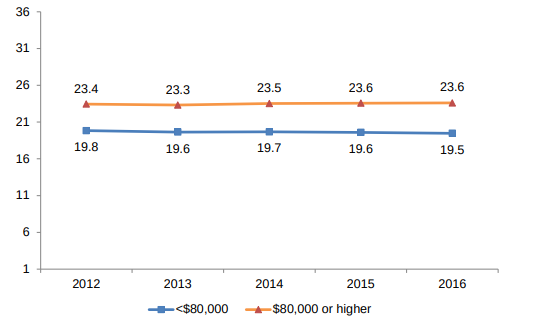
Similarly, in 2016, CB competitor ACT.org released statistics on average ACT score by family income. For students with families making above $80,000 a year, their test scores were, on average, nearly point points above the average of that of a student who’s family makes less than $80,000. This could be from a wide variety of factors, such as population density, housing, access to resources, education quality.
For over a century, the College Board has worked to make education efficient but competitive. In that same “Delivering Opportunity” speech Coleman gave, he made it abundantly clear that their intitiative was to lift those up who deserve opportunity.

Meritocracy, on paper, is a completely acceptable and sensible way to construct society. Those with higher capabilities, higher intelligence, higher motive, and stronger ethic will thrive in society. Students who choose to push themselves, have a higher g.p.a, and participate more will get into higher ranking colleges. Opportunity is based on ability.
What if, conversely, ability is based on opportunity? Across the U.S, quality and accessibility of education vary significantly. In an education system designed around metrics such as AP classes and SAT scores, isn’t it wrong that not even all schools offer the same? According to APCentral, 52% of Native American students attended high schools with 5 or more AP courses in 2023-24, in comparison to 93% of Asian students, 84% of Hispanic/Latino students, 77% of White students, and 76% of Black students.
On top of varying accessibility based on ethnicity, financial factors hold many back as well. According Dana Goldstein from the New York Times, “Some 60 percent of A.P. exams taken by low-income students this year scored too low for college credit.” This statistic has remained the same for the entire 21st century. The College Board hasn’t done quite enough to bridge that gap, however. Only recently had they introduced a fee waiver, and in 2019 CEO Coleman even admitted “What the SAT is…[is] a valid measure of your achievement…But what it doesn’t measure alone is…what you’ve overcome — the situation that you achieved that in.” Should we base a student’s academic success so heavily on a few standardized tests that don’t account for these things?
The College Board has inserted it’s pure meritocratic ideology into the American education system, and though the organization genuinely attempts to lift students up, their ideology has flaws. Disparity, unanimity, and efficiency serve to weaken their effect, and these are some key areas that should be improved upon.

On the topic of ideology, the big C.B. has shown a lack of confidence in it’s own values. In 2023, while Florida Governor Ron Desantis was on a crusade to fictionalize the existence of slavery and discrimination towards African Americans, he targeted the College Board. The Board, which has pledged to uphold quality education and serve the nation to its fullest, immediately folded under Desantis’ pressure to remove key topics from its AP African American Studies curriculum. Disappointedly, ignorance and bigotry stood victorious over the board. The Florida Department of Education responded in a letter, saying “By no coincidence, we were grateful to see that the College Board’s framework removed 19 topics, many of which FDOE cited as conflicting with Florida law, including discriminatory and historically fictional topics,”
The College Board has a vital grip on U.S. education, and at the moment, their methods of classifying students are far too broad. The “not-for-profit” organization’s handsomely-paid execs and millionaire CEO gouge just about every dollar they can out of schools, educators, and student’s for little to no reason, and their operating costs do not justify the business-like practices they exert. David Coleman preaches of “beautiful and effective” tests designed to accurately place students in percentiles, when in reality they absolutely disservice minority racial groups and lower-income households. To combat this, they could use just a portion of their $1.1 billion in revenue each YEAR to expand their offered classes, tests, and curriculum.
What the College Board ends up perpetuating is a cycle completely contradictory to its original purpose to negate privaledge and promote merit. The privaledged are more likely to achieve that merit, and the underprivaledged, by design, are not. Equal opportunity is not yet a reality attained by the board, and to achieve equity, it is direly needed that the organization’s absolutely massive government of Trustees, National Assemblies, Regional Assemblies, and Freddy Kreuger and whatever the hell else finally design some worthwhile tests with much more depth and accuracy to them.
While following an honorable cause, providing useful resources, and guiding colleges with helpful admissions stats and scores, the College Board needs to reassess its priorities, recognize it’s influence, and finally take a more proactive role in fostering an effective education system.